Cricothyrotomy: What It Is and How It’s Done
 Jason Hine
9 min read
What Is a Cricothyrotomy?
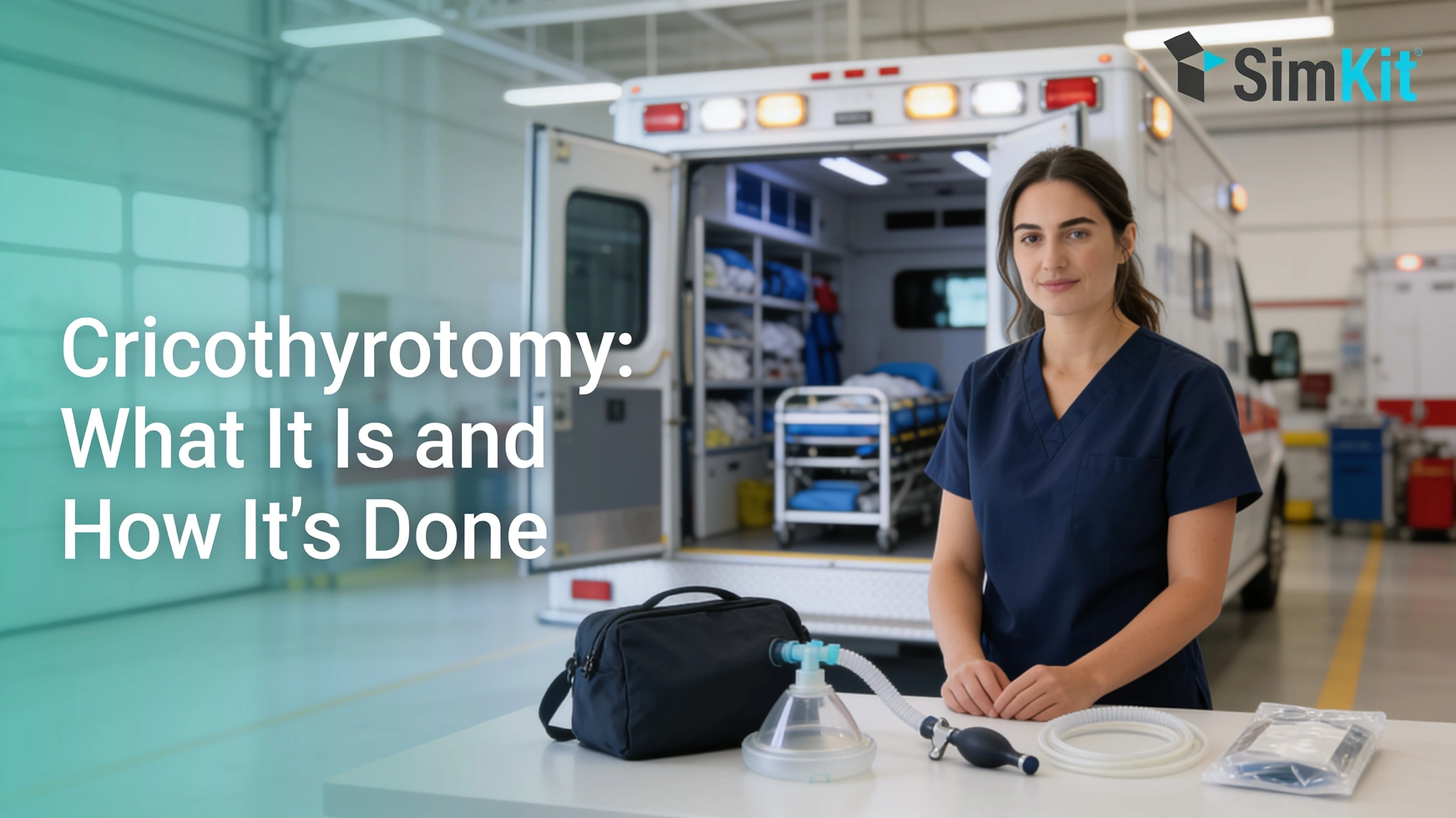
A cricothyrotomy is an emergency airway procedure. You make a small incision through the cricothyroid membrane, the soft gap between the thyroid and cricoid cartilage. Then you pass a breathing tube into the trachea.
It is a last-resort rescue airway. You reach for it when you cannot ventilate or oxygenate a patient by any other route.
You will see it written two ways, cricothyrotomy and cricothyroidotomy. The words mean the same procedure, and clinicians use them interchangeably.
It differs from a tracheostomy, which enters lower through the tracheal rings and is usually planned. A full comparison comes later in this article.
Why Cricothyrotomy Is Rare and Why That Matters
Most clinicians go years between crics. A study in the Journal of Emergency Medicine on how often surgical airways happen reports that surgical airways are a high acuity, low occurrence procedure, occurring in less than 1% of all patient encounters in both the prehospital and emergency department setting.
That rarity is the whole problem. A skill you use less than once a year fades, and the cric is high stakes exactly when it finally arrives.
We have written before about how rare crics are across modern practice. Readiness fades unless you maintain it on purpose, so this article treats the procedure as a skill you keep sharp.
The Anatomy: Finding the Cricothyroid Membrane
Because readiness starts with the landmarks, begin with the anatomy. The cricothyroid membrane sits between the thyroid cartilage above and the cricoid cartilage below.
You can find it about 2 cm below the laryngeal prominence (the Adam’s apple). Aiming here keeps you clear of the thyroid gland and the larger vessels lower in the neck.
The blood supply is close but manageable. The superior thyroid and cricothyroid vessels run near the membrane, and the carotid and jugular vessels sit off to the sides.
Two methods help you locate it fast. The laryngeal handshake steadies the larynx between your thumb and fingers so you can walk down the cartilage. Point-of-care ultrasound can confirm the membrane when landmarks are tough to palpate.
Staying in the midline is the habit that protects you. The larger vessels run to the sides, so a centered incision keeps the field cleaner and lowers the odds of heavy bleeding.
When Is a Cricothyrotomy Needed? (Indications)
With the anatomy in hand, the next question is timing. The core indication is the cannot-intubate, cannot-oxygenate (CICO) scenario, where you cannot pass an endotracheal tube and cannot oxygenate with a mask or supraglottic device.
A cric is the final step in the difficult-airway algorithm. Once CICO is declared, waiting only deepens the hypoxia, so the decision to cut has to be quick.
Common triggers include:
- Severe facial or maxillofacial trauma that blocks the mouth
- Massive oral or upper-airway hemorrhage
- Copious emesis that defeats suction
- Oropharyngeal swelling from angioedema, infection, burns, or anaphylaxis
- Fixed anatomic obstruction, such as a tumor or foreign body
Contraindications: When to Pause or Choose Another Route
Those triggers force the decision, but a few situations still shape it. In a true CICO emergency there are no absolute contraindications, because the alternative is a dead patient.
Relative contraindications still matter when you have a moment to weigh them:
- Prior tracheal surgery that distorts the anatomy
- Known laryngeal fracture
- Suspected laryngotracheal disruption
- Very young age, where the anatomy shifts the approach
- Inability to identify the landmarks
Young children are the clearest example of anatomy changing the plan. Their small, soft airways push you toward the needle approach covered below.
The Three Main Techniques
Once you commit to the cric, the method depends on the patient and your kit. Two techniques handle most adult cases, the scalpel-finger-bougie approach and the percutaneous Seldinger method. A third, the needle technique, is used mainly in young children.
The Difficult Airway Society guidelines recommend scalpel cricothyroidotomy as the preferred rescue technique and say it should be practised by all anaesthetists.
Choosing among them comes down to a few factors:
- Young children need the needle approach because of their smaller, softer anatomy.
- The Seldinger method only works when the commercial kit is on hand.
- Favor the technique you have actually practiced, since drills beat theory under pressure.
- In a crashing CICO airway, the fastest reliable method wins.
| Technique | Best suited for | Key equipment | Notes |
|---|---|---|---|
| Scalpel-finger-bougie | Adults in the ED | Scalpel, bougie, cuffed 6.0 tube | Preferred emergency approach; fast with minimal kit |
| Percutaneous (Seldinger) | Providers trained on the kit | Commercial wire-guided kit | Needs the specific kit ready |
| Needle | Children under 8 to 12 years | 12- to 14-gauge angiocatheter, bag-valve mask adapter | Temporizing only; must convert |
Scalpel-Finger-Bougie (Surgical) Cricothyrotomy
This is the preferred ED approach because it is fast and uses gear you already have. It relies on a bougie (a thin, flexible introducer) rather than a full kit.
The steps run in order:
- Stabilize the larynx with your nondominant hand and identify the membrane.
- Make a vertical skin incision over the membrane.
- Make a horizontal stab through the membrane.
- Keep the blade in place and sweep a finger through the opening.
- Slide the bougie through the opening and downward into the trachea.
- Railroad a cuffed 6.0 tube over the bougie.
- Inflate the cuff and remove the bougie.
- Confirm placement with capnography (a measure of exhaled carbon dioxide).
- Secure the tube.
For a sense of how this plays out under pressure, a real cric case walks through a crash airway from decision to confirmed tube.
Percutaneous (Seldinger) Cricothyrotomy
The Seldinger method uses a wire to guide the airway into place. It needs a commercial kit, so it works only where that kit is stocked and familiar.
The steps run as follows:
- Insert the needle through the membrane at about 45 degrees, aiming caudally with gentle back-pressure on the syringe.
- Watch for an air bubble, which confirms you are inside the trachea.
- Thread the guidewire through the needle.
- Advance the dilator over the wire.
- Place the airway catheter, then remove the wire and dilator.
- Inflate the cuff, then confirm and secure the airway.
Needle Cricothyrotomy (and Pediatric Use)
Needle cricothyrotomy buys time rather than securing a definitive airway. You insert a 12- to 14-gauge angiocatheter (a large-bore IV-style catheter) through the membrane at about 45 degrees, aimed caudally.
Aspirating air confirms tracheal position. You then attach the catheter to a bag-valve mask, often through an endotracheal tube adapter, and ventilate.
This approach matters most in children. The pediatric needle cricothyrotomy guidance from the Merck Manual notes that needle cricothyrotomy uses a 12- to 14-gauge angiocatheter and is the preferred cricothyrotomy method for children under 8 to 12 years old, because of their anatomic differences compared with adults.
Because it only temporizes, plan for a definitive airway right away. The needle keeps oxygen moving while you set up a surgical airway or get the patient to the operating room.
Complications and How to Reduce Them
Whichever technique you use, complications split into early and late. According to reported complication data in StatPearls, significant hemorrhage occurs in up to 50% of cases and, in rare instances, may lead to asphyxiation or aspiration.
That figure describes significant bleeding, not the minor oozing expected at any neck incision. Read it as a cue to control the field and move with intent.
Early complications and their fixes:
- Significant bleeding can obscure the field, so stay midline and apply direct pressure once the tube is placed.
- Pushing the tube too deep causes mainstem intubation, so insert only a few centimeters and check bilateral breath sounds.
- Forcing the tube can create a false passage into the tissues, so pass a bougie first and feel for tracheal rings.
- Hard posterior pressure can injure the back wall of the trachea, so angle the blade and bougie caudally.
- Hypoxia builds during a slow attempt, so keep attempts brief and preoxygenate whenever time allows.
Late complications tend to show up after the emergency has passed:
- Subglottic stenosis, a narrowing below the vocal cords, can develop over weeks.
- Voice changes and hoarseness can follow injury near the vocal cords.
- Dysphagia, or difficulty swallowing, is reported in some patients.
- Infection at the incision site is possible and needs wound care.
Aftercare and Converting to a Tracheostomy
Managing those risks continues after the tube passes. Use continuous capnography and pulse oximetry, then get a chest radiograph to check tube position and rule out barotrauma.
The timing of conversion to a tracheostomy is now debated. A 2022 meta-analysis of 18 studies and 1,246 adults in the Journal of the American College of Surgeons found bleeding around 5% and subglottic stenosis near 0%, comparable to tracheostomy, which challenges the old 72-hour rule.
My read is that the 72-hour rule may be softer than once taught. The decision still depends on the patient and local practice.
Either way, the cric is a bridge to a controlled airway. Involve ENT or trauma surgery early so any conversion is planned rather than rushed.
Cricothyrotomy vs. Tracheostomy
That conversion question depends on how the two airways differ. Both create a surgical airway, but they sit at different points in the neck and serve different jobs.
| Feature | Cricothyrotomy | Tracheostomy |
|---|---|---|
| Location | Cricothyroid membrane | Tracheal rings (lower) |
| Speed | Seconds to a couple of minutes | Longer and more involved |
| Setting | Bedside emergency | Usually planned, in the OR or ICU |
| Who performs it | EM clinicians, some paramedics | Surgeons and trained proceduralists |
| Main role | Rescue in CICO | Longer-term airway |
Cricothyrotomy wins in a CICO emergency for one reason: speed. The membrane is shallow and easy to reach, so you can secure an airway in seconds rather than minutes. A tracheostomy takes longer and belongs to controlled settings, which is why it usually follows the emergency rather than replacing it.
Staying Ready for a Procedure You Rarely Perform
All of this only helps if you can do it when it counts, and that comes back to the rarity problem. Mental practice for crics keeps the sequence fresh between the real ones. Practicing while training under realistic stress helps your hands hold up when the real patient arrives.
Our evidence behind simulation training review ties repeated practice to the earned confidence clinicians rely on for rare procedures. That thinking drives SimKit’s the procedural training course, a 12-month program that revisits each procedure in about 30 minutes a month.
You can see how at-home practice works, with the cricothyrotomy kit shipped all-inclusive and the models yours to keep. The annual plan is accredited for AMA PRA Category 1 Credits.
Frequently Asked Questions
Is it cricothyrotomy or cricothyroidotomy?
Both terms describe the same procedure, and clinicians use them interchangeably.
Can an EMT or paramedic perform a cricothyrotomy?
In the United States, scope of practice is set by state and local EMS protocols. Many paramedics are authorized to perform it, while EMT-basics generally are not.
What is the difference between a cricothyrotomy and a slash tracheostomy?
A slash tracheostomy is a crude, unplanned cut into the trachea. A cricothyrotomy goes through the cricothyroid membrane and is the faster, safer emergency choice.
Why is a cricothyrotomy converted to a tracheostomy?
Conversion has been used to lower the risk of subglottic stenosis from a tube left in the cricothyroid membrane too long. Recent evidence, covered above, questions whether it is always needed.
How is the cricothyroid membrane found?
You locate it about 2 cm below the laryngeal prominence using the laryngeal handshake. Ultrasound can confirm it in an obese or swollen neck.