
Contributors: Josh Guttman MD and Jason Hine MD
I love teaching procedures. But when a learner gets stuck, it’s easy to fall back on, “Here, just do what I do.” That’s like Patrick Mahomes throwing a perfect spiral, handing me the ball, and expecting me to do the same. I saw what he did. I still have no idea how to make my hands do it.
To talk through what we can do instead, I’m joined by Dr. Josh Guttman, an emergency physician at Grady Memorial Hospital, associate professor of emergency medicine at Emory, and founder of Peachtree POCUS. Josh teaches point-of-care ultrasound and helps EDs build the programs that support it. He spends a lot of time helping learners figure out what to do with their hands when the view on the screen is almost right.
Transcript
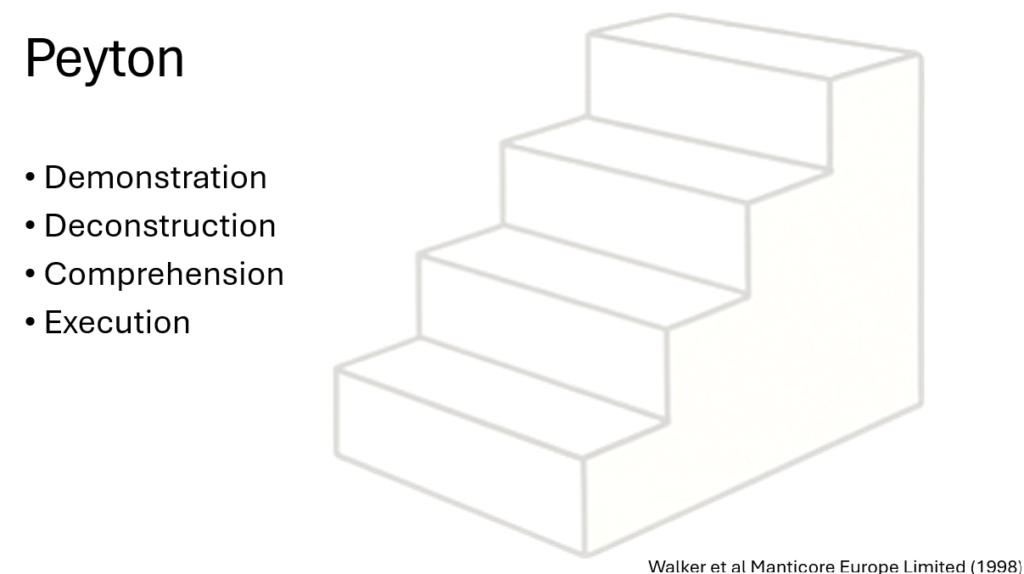
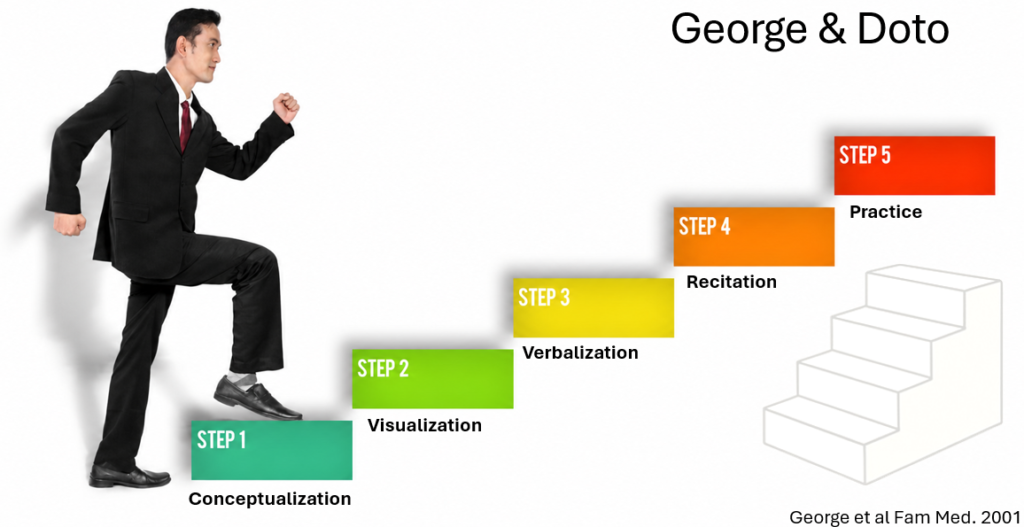
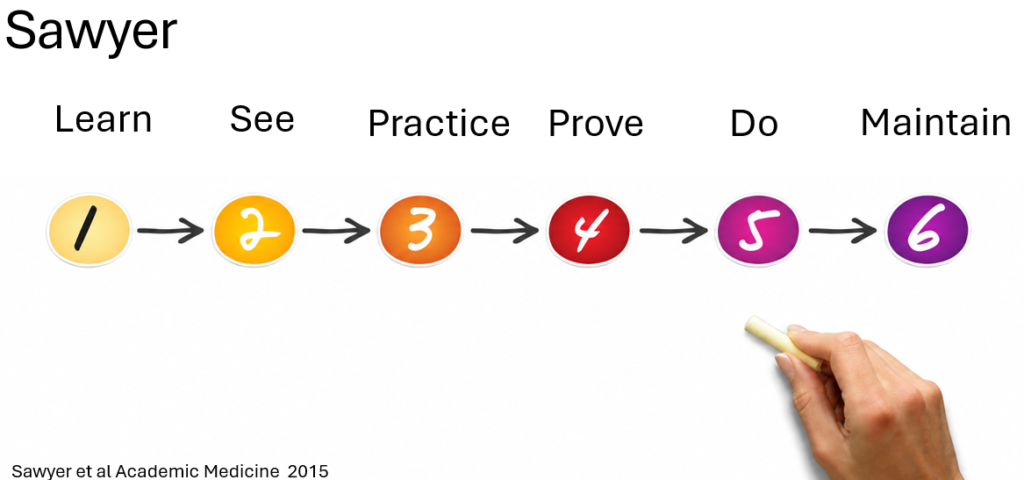
Hello, everybody. Welcome back to the Sim-Kit Podcast. Today, we’re gonna be talking about teaching procedures, which I’ve always found to be sort of a double-edged sword. I love it. It’s super fun. Obviously, it’s a passion of mine with Sim-Kit, but it has elements to it that are very complex and sort of ever-shifting, you know. We’re teaching residents, medical students. If you’re important or you’re involved in the onboarding of your docs or your PAs, you have a wide spectrum of people that you have to teach. And sometimes, you know, people just get it. You either feel like you’re flowing with a learner, and your knowledge is going into them right away, and that’s smooth and fantastic. But then when peop- people start struggling, or you find that there’s just that block or you can’t get past a challenging part of it, it can get really frustrating as an educator. And I find sometimes we just default into this, “Here, just do this. Just do what I do. Here, this is how you thread the needle,” or, “This is how you re- you know, reduce the shoulder.” Uh, your expert consensus comes in, and you just show the learner how to do it, and then they’re supposed to replicate that. In my mind, that’s like, you know, I’m not a football player. You got Patrick Mahomes, who tosses a 75-yard perfect, uh, spiral to a receiver, says, “Here,” hands me a football, and then I have to try to do the same. It’s not gonna ha- happen because I don’t have the skills, expertise, and reps that the wonderful or terrible, depending on your team- … Patrick Mahomes might have. So today we’re joined by a special guest in Dr. Josh Gutman. He’s an ultrasound, EM ultrasound extraordinaire and does a lot of teaching in the tactile space. He’s the founder of Peachtree POCUS, and we’re very excited to have you on the podcast today, Josh. So tell the listeners a little bit about yourself. Hey, everyone. Um, like Jason said, I’m Josh Gutman. Um, I’m the founder of Peachtree POCUS. We do, uh, point-of-care ultrasound education and operations consulting, um, hel- uh, not only delivering, uh, courses, uh, throughout the country and beyond, um, regarding, uh, all sorts of, uh, ultrasound procedures from basic to advanced, um, but also focused on the operations component and getting your ultrasound, uh, program up and, up and running with archiving and billing and everything to, uh, uh, to really make it reimbursable. Um, in my, uh, uh, other job, I’m a emergency physician, as, as Jason said, at Emer- at, uh, Grady Memorial Hospital, and I’m an associate professor of emergency medicine at Emory University, and I’ve been teaching procedures in ultrasound for, you know- Well, within probably 15 years or so. So, um, definitely a big, a big passion of mine, and procedure’s a big passion of mine, whether it’s, um, ultrasound or, um, other procedures that we do in the emergency department. Perfect. You’re a great guest to have on, so thank you for joining us. You know, the, the ultrasound either used in procedures or the knowledge and skills acquisition side of getting that window and view, that’s right in your wheelhouse, and that’s kind of what we’re gonna be talking about today. And Josh, what I find is there’s a major difference between knowledge translation, you know, how to interpret an EKG, the causes of anemia, that versus a tactile skill education, and it just becomes more complex and harder pretty quickly. Why do you think that might be? I, I would– i-it’s because there’s more to incorporate than just in-interpreting what you’re, what you’re seeing on a, on a screen. So in ul-in ultrasound, there is the, uh, the procedure is the image is first deciding to do the procedure, which is one thing, uh, which is a little bit less difficult than ultrasound, but there’s the image acquisition and interpretation. So if you’re looking at an EKG or you’re trying to decide on a therapy, some other decisions that we make, uh, you know, which medication should I choose? It’s– the decision is single. It’s just what am, am I choosing amongst the options? It’s something that could be more memorized. Okay, I use, you know, Zofran in this situation, Reglan in this situation. And, uh, but, but with ultrasound procedures, there is that I have to interpret what is going on. I, I have to know that what I’m seeing on a screen in ultrasound is what I’m supposed to be seeing, and there’s also the tactile movement of the hands, and then they have to combine the, the two together. So you only– you have multiple aspects of that, and various learners have difficulty in different aspects of those things. So it’s just a, a more combining your hands and your brain and putting them together, which sounds simple, um, but for a, for a lot of people, that’s difficult. And each part of the procedure itself, and sometimes they’re an extensive amount when you think about putting in a central line or chest tube, that’s got multiple steps to it. And so they not only have to be good at the, uh, let’s say with central line, interpreting the right vessel on the ultrasound screen that it’s appropriate, but then having the probe in one hand, the needle in the one hand, and, and, and combining those two is more difficult than saying, “Oh, here’s a kidney. What am I looking at on the screen?” Where it’s just the, uh, you don’t have all those steps. Yeah. Fair. Yeah, I think that when we sort of think about that and state aloud and, and sort of break it down, I find it’s kind of a procedure is, you know, knowledge-based, knowledge translation. We need to get the knowledge into the brain of the learner. Pairing it with a case or having them do it in real time is a great way to send that into their brain. Procedures or even, you know, the ultrasound image acquisition part of procedures is knowledge translation plus. So you have the knowledge they need to have. If it’s a procedure, it’s, you know, indications, contraindications, the materials, the steps. But then they also have to have psychomotor skills, dexterity and things. And the wrinkle that often is overlooked is the real-time interpretation and decision-making and feedback. So things change and can change pretty rapidly when you lose your needle tip, and they just keep advancing. Um, but they have to respond to that in real time. And then we pair that with the fact that this is far more high-stakes. We have time to figure out the cause of hyponatremia or interpret the EKG or figure out the reason for anemia. In a procedure setting, we have to balance the patient’s safety, number one priority, the, uh, learner’s anxiety, and our supervising role all together at one time. And then we have the variability in there. We have variability in where learners come in, what they’ve done in that procedure in the past, their own dexterity skills and aptitude, and this all makes for very difficult sort of learning environment and manipulation or small changes in real time. I like to go back in my brain when it, it gets cognitive view– cognitively overloaded to think about what we’re trying to do. Our main goal is to balance, as I said, patient safety, priority number one, learner autonomy, and our supervisory role. And it all gets kinda jumbled into one big pot and stirred together sometimes if we don’t think about those sort of aspects and competing interests before we go into the room to do the procedure. Yeah, and allied learner safety too. They have to feel confident that they’re going to, you know, they’re, they’re not going to harm… They, they, they want to know that they’re not gonna harm the patient. If they’re feeling a lot of pressure because of time or because of, um, uh, the supervisor, uh, their perceived supervisor not giving them a lot of, of leeway, plus they obviously wanna do well for their patients, um, if they’re not in the right mindset to have confidence in this procedure or that they will be appropriately walked through, then they’re not gonna, they’re not gonna perform as well when their part of their brain is worried about all the other steps as opposed to just, like, you know, getting the needle into the right spot or doing the procedure. Yeah. Yeah, that’s a good point too to sort of add that even itself into the mix. And so with all those parts that come together, you know, our listeners know I wear my med ed and med ed literature hat a fair bit in sort of talking about and teaching things. In the space of procedural skill acquisition and teaching, I find the med ed lit to be quite lacking. There are definitely publications out there. There’s Peyton’s four steps. We got George and Dodo who went further with five steps, and then a few years later we had a little bit of a spinal tap situation where Sawyer went to six steps. You know, the amp goes to 11. Everyone kept adding steps. And if you haven’t seen those, those, uh, structures are gonna be in the show notes. But just for people who are unfamiliar with them, Peyton started with demonstration, which is we as the provider, it’s a little bit old school, sit down and show the procedure start to finish, no talking. Then we deconstruct it for them. We talk through the procedure as we do it. Then they get to sort of recite it or show their comprehension, and then they finally get to do it. Now, basically, you’re gonna show the procedure, break it down, the learner goes over it, and then they get to practice. George and Dodo added one step of they need to come in with some conceptualization, that sort of that pre-learning usually of indications, contraindications, material steps. And then Sawyer, I appreciate with SimKit, we talk a lot about skill decay. Sawyer added a maintain step at the end. So once you get to the finish line of I can successfully do this procedure without risk or complication, then you have to maintain your skills. So Josh, are you familiar with these, uh, processes or structures at all? Do you find them they’re useful in clinical practice? And sort of just describe your overall prac- uh, processes for helping us teach someone what to do with their hands. Yeah, I was… I’m more in the, the, the George camp. Um, and, uh, I, I, I, I hadn’t, I hadn’t learned about the, the Sawyer, the additional, but that, that is something we talk about a lot in ultrasound, just, just haven’t, um, named it. But, um, having them, having them work through the procedure in, in, in real time, um, and then that skill and then h- having done that and gotten that to the end, right? So they’re even in this practice, they’re doing the procedure Let’s say it’s an IV on a, even on, on a, a phantom gel model, and when they finally get it in, and they’ve, they’ve honed that procedure and gotten that tactile feedback and done all that on, uh, on, on the, the gel model, it’s really about maintenance. And we, we talk about this a ton in the ultrasound world about maintenance of skill. And in all the skills that we do, uh, when they’re integrated more into clinical care, and I, I use the stethoscope as an example, and when, when folks are taking my courses and they go through kind of a two-day, a one or two-day boot camp-ish, like, okay, and they kinda get that skill, I say to them, “Well, you can’t just… You know, when you learn to use a stethoscope, you didn’t just learn in your second-year med school or learn when you were doing your, your, uh, your clinical rotations. Okay, like here’s a stethoscope. I’m gonna now pick up a one on six m-murmur.” You had to get feedback. There had to be an instructor or an attending staff or someone who would then listen after you and say, “Oh, that was good.” And then you did this on every single patient that you saw, and that’s how you develop the expertise. It’s the same with ultrasound and any of these procedural s-skills. And, and in, in ultrasound, and people kinda go home, and now they wanna use it. And now they’re gonna use it not only on, on mannequins and on models in an ideal course setting, now they’re using it on your, uh, technically difficult patients. They’re doing their ultrasound-guided IVs on someone who’s, uh, obese, who has fewer vessels, uh, available because they were an IV drug user. There’s the pressure of your clinical schedule, like I need to get through my patients. I have to see the next one. This patient needs their IV. And all that doesn’t exist in a course setting. And so having to often repeat, and that spaced repetition is so important in skill maintenance and then, and, uh, i-in actually doing it in real life. And as far as just a regular diagnostic ultrasound, if you don’t do echoes on difficult people, you’re never gonna learn how to, how to, how to do it well on the patients that you’re, you’re taking care of. And in my experience, you know, people can, uh, interpret an ultrasound on a, on a screen in front of them when they’re– during a, during a lecture, uh, and they can do an ultrasound when they’re there. But then when they start to do it in practice and are like, “Well, this isn’t so clear if the ejection fraction is low, and I’m not sure,” and they might take a good guess, but they need that feedback to to let them know like, “Hey, this ultra– you, you did a good job,” or, “Actually, if you notice this on the screen, this is a little bit, this, uh, the ejection fraction’s actually normal.” And doing that more and more, kinda that repetition learning that comes with doing and feedback on their own scans is what creates that competence, and that’s so important in, uh, i-in ul- in ultrasound learning. And I, I could not stress enough for learners that that spaced repetition, I, I think both on the evidence and, uh, in experience, is what creates the expert, uh, uh, going from a novice rather to, to competence and eventually to expertise in, in the procedure itself. Well, I, I like that explanation globally of, you know, sometimes it’s a matter of guidance and direction, but also the learner taking the time doing those reps with your graduated autonomy you talked about, and sort of helping correct in, in real time, but also just knowing that there are pain points, there’s growing pains as they develop their skills, a proceduralist or ultrasonographer. I think in that same space, sometimes where I get stuck is in that demonstration spot, right? They talked about that as one of our major steps in teaching a learner how to go through and, and gain that autonomy. And coming back to Patrick Mahomes, you know, he can take that football and toss it and throw a perfect spiral. A- an expert can make something look effortless, where a learner really struggles to do the same. And in ultrasound in particular, so you have a learner with a probe and they just can’t get that view, and you make that very subtle adjustment to make it perfect. Now, the learner sees you do that, but they don’t really understand exactly what you did to get to that point. So in these micro-motion and small probe adjustment spaces, how do you make the movements sort of visible and understandable for a learner? Yeah, that’s a great question. And, and when… as I involve- evolved in my career as an educator, um, I did a lot of ultrasound early on, and then I, I just got a lot of muscle memory and was able to sort of translate it into expertise just doing a lot. But when then I transitioned into teaching, I had to think back to myself, “Well, how did I get this apical four-chamber view? I just put the… I just put the… it on, and I don’t know. Like, I just get this view,” right? And that, that, that is what it, it was at the beginning, and then as I’m teaching during fellowship and beyond, I had to actually sit and look at my hand and, like, break it down. Like, what am I actually doing? Because that’s what the learner needs to know, ’cause it’s like, “Oh, just put the probe here and you’ll get it.” And I had this experience early in my career. I, I struggled at ultrasound-guided IVs, and so I appreciate when learners have difficulty with it, and had the li- the attending when I struggled be like, “Oh yeah, you just see the vessel here,” and you put it in. I was like, “Well, that, that wasn’t helpful at all,” right? It’s great. And so I had to think back and say, and say, “Okay, well, well, how do I make, how do I make these micro movements?” So I had to establish that in my own practice first. What was I doing as someone who, who, who can get a great view every single time, or at least as much as possible? Um, and I had to break down those movements into myself. So I would say for educators looking to teach ultrasound but also looking to teach any other procedure is break down your own steps that you may have developed inherently. What did your body decide to do, and what is your mind doing at each time? And make that a stepwise process. And then when I have a learner I first, if they have learned– usually they’ve had some sort of– they’ve learned a little bit before. So if it’s not the first time they’re putting their probe on a patient to do an apical four-chamber view, I look at– I, I just watch them do it, and then I break down those micro steps of like, okay, here, first you put the probe, uh, where you would feel the PMI because they’ve learned PMI in medical school. And it’s like- Right … “Oh, that’s you. Okay, you have, you have that there. Okay, now, now what you h- you’re gonna turn your probe this way. And if you imagine the heart up in the chest, if you’re gonna look up through the heart, how would that look like?” And that is inherently makes sense ’cause that’s what I’m doing in my mind and break that down and say, “Okay, move a little bit more medially along this r- rib space while constantly, uh, look- looking through to get your view. Move a little bit that way,” um, in a parasternal long. So you’re putting– you’re taught to put it in the, in the third to fourth, uh, interspace parasternal, but what it like– but you, in a lot of– some of the time you don’t get that view. Well, now I window shop, and so I go and that, you know, will– that helps them remember. Now go down an interspace and look, and it’ll pop out at you when it comes. And so breaking those down into those micro steps and saying, “Okay, well, I was good at putting the probe on the patient in this spot, but I need to then… This is the movements I need to make.” And so they can have a sequence in their own minds until they develop that muscle memory. That’s how I’ve learned to teach ultrasound is, is you re- you really break it down into its micro steps. So someone puts the probe down, they’re like, “Okay, well, what do I do now?” And so, “Okay, you know, Guttman said you gotta do this.” And so– And then till it turns into– until all of a sudden it clicks I like that. And I, I like the– I use the same general idea. I take a procedure when I’m teaching it and sort of think about the macro and the micro skills, the macro and the micro that go into them. Uh, and the, those are important steps to, one, recognize almost as their own individual competency space. And then if it’s a macro skill and you can break that down further to understanding how do you prevent needle kinking when you’re trying to do your, uh, wire or your dilation? How do you prevent decannulation? How do you, you know, hold your hand on the, uh, non-dominant hand on the patient to keep it steady and still when you take the syringe off? And so there’s a lot there when we start with the process of, like, find the vessel, we think that’s a step, that’s a skill. But when you actually kind of get into that, there’s huge pieces within each of these. Where do you position the probe to start? How are you anchoring your hand? How much pressure are you applying? Are you gonna rotate, pan, tilt? All of those things can kind of come together to form a larger entity within the procedure itself. So it’s kind of chopping the onion into small pieces, uh, and then recognizing within that how you can advance from one to the next to the next. And I’m wondering specifically, Josh, in the space of ultrasound, this can get maybe word-heavy. So say a learner takes the probe, puts it on the chest, and doesn’t get a good view. Tell me about your If you have competing interests about how much you’re talking, how much cognitive load you’re putting on the patient, and how you relate what you need to relate to them sort of in bite-sized elements. There’s two schools of thought in, uh, this type of thing, and it’s the, the more talking and let the learner do more independently and struggle a little bit more versus actually putting your, your, um, hand on the probe with the learner’s hand, um, with permission of course, uh, to help them to, to get them into that view. And I, I prefer to talk them through the procedure a little bit more, and I let them struggle, and I think that’s, that is not like, okay, once they… If they haven’t turned the probe, if they haven’t done what they need to do, the struggle is part of the learning. Yeah. And so they learn what needs to happen as they, uh, try to get the view and don’t get it. And there’s a point that you can tell, okay, they’re getting frustrated now. It’s clearly not working. And so now I gotta step in and talk them through. And so I will tend to talk them through a little bit more. Um, if that’s still struggle, then with permission I’ll, I’ll move their hand so they get that, they develop that muscle memory. Uh, ’cause sometimes just having their, their hand know what to do tells their hand to their brain, “This is what I’m supposed to be doing now,” whereas talking through it, um, might not. But it’s still break it down into those micro steps. “Okay, now turn your, you turn your probe clockwise. Move your probe towards the feet down, you know, just a couple of inches.” And so y- usually talking them through can get them to do that. But the str- you have to have the struggle, because if they just were like, “Okay, he told me to do this, and so I did that,” they may not process it as much as, “Okay, he told me to do this, and that’s what it looked like.” Um, a- a- and, and if I told… If I, you know, f- w- if I, if you didn’t struggle through it- They’re not going to be able to develop those, uh, their own internal, uh, hurdles. And so I try to talk as much as I need to talk, but first they start with the struggle. Yeah. I, I appreciate you saying that. People don’t often sort of just admit aloud that challenge and even little bit of frustration and a little bit of struggle is okay for a learner to experience, and actually oftentimes a good memory aid. You know, they’re having issues with th- their probe and their hand positioning. They do five movements that don’t work. That’s frustrating. Then they do indeed find the right view. That’s creating a nice little anchor for them to make that process work more smoothly in the future. Um, so I like that element of struggle. And I also appreciate the idea of we’re talking about adult learners, right? And adult learners learn best when they do. So you having your p- hand on the probe and their hand on you, like the movie Ghost making the, the pot, you know, on the thing, maybe not gonna be as educational as them actually holding the probe themselves and responding to these sort of simple audio cues that you’re giving them. Pan, you know, pan to the left and drop down one rib space. A digestible element, but them in control, and a little sprinkle of struggle in there seems like a great, uh, tip and trick for people to develop the skills for the long term. You know, it’s easier to get them through that one apical four-chamber view if you hold their hand and show them the view. But taking that little extra time, let them struggle through it a little bit, and allow them to find it on their own is gonna be much better learning. So I like that. Yeah. A lot of what I do now, uh, in, in r- real practice, and so I teach ultrasound, uh, clinically, um, uh, a lot of the l- the learners have generally, the interns get a boot camp very early on in their training, so they go through a lot of the skill- the, uh, basic skills they need to get, and there’s various levels of retention. And so I always have them do it on their own. And so they go, they go to the patients. They don’t worry, “Oh, now there’s the attending who’s gonna stand over me, and now I’m doing it.” And I, I, I have very s- I, I, I very strongly believe that having too much supervisor there n- and, uh, uh, creates, uh, too much pressure, and then they worry about time, they worry about performing, and they worry about the struggle, that if you let them go do it on their own, again, this is presuming they have some basics and it’s not a critical patient, letting them struggle through it on their own, coming… And then I come in, I said, “Hey,” and this happened, uh, shift last night a couple of times. Like, “I’m struggling with the parasternal. I, I couldn’t get a good parasternal long axis view.” Right? And this, the, the resident, so it’s an intern who had just come off an ultrasound rotation, said, “Okay.” It took the time to, to do it, and said, “Okay,” now we went back to the bedside together- And I said, “Now sh- now show me what you’re doing.” And then based on that, they had that internal struggle already, and so I was doing this. I said, “How about you come down another rib space?” And then all of a sudden it pops into view. They had that internal struggle already. They went through it without me needing to be at the bedside. Mm-hmm. Obviously, there’s a lot of patients to take care of, but we get to go address the struggle together in a shorter time window, and all of a sudden it’s like, wow, I, you know, messed this up at the beginning. You know, they didn’t notice, obviously there was no patient harm, but I messed this up at the beginning, and now I got real feedback on what exactly I was doing and what was wrong without the external pressures. And I am, I’m a very strong believer in, in that, in needing, needing to be on your own, do it in the struggle, um, without the external pressures, and then, and then getting that feedback afterwards Yeah, yeah. I– Good. I appreciate that in you. That’s fantastic to give them that little realm of experimentation, space to, you know, uh, learn and figure out if they can struggle through and overcome, and then intervening essentially when they cannot. And, um, that’s a great structure, and I think here’s an area where I wanna get into the nitty-gritty in the spaces of when someone’s– we’re trying to obtain an ultrasound view for diagnostics, that is maybe, I don’t know if I wanna say necessarily lower stakes for the patient, but it’s different than we need central venous access, or we need to place a chest tube between this rib space. Yeah. And so I wanna sort of take us from either the, you know, SIM space or ultrasound for diagnostics into the procedural space and kinda come into the sort of patient with the potential for either adverse outcome or awkwardness or challenges when we’re working with a learner and a patient’s in a room being worked on, if you will. Okay? Yes. Um, and so that space, it’s definitely, you know, the ante gets upped, and especially when you’re working with early learners. When they’re gonna be doing a procedure or into putting a needle through a patient, say, for the central line, you know, they have a lot of shade being thrown their way, whether it’s the nurse who’s saying, “You’re gonna have this, you know, medical student try to get the central line,” or the patient family, the patient themselves. And all of that stress and pressure is already very heavy on their shoulder. And for me, I’m always thinking about how I– my job is to try to take as many of those weights off as I can. And the simplest thing I do in my brain is just before, during, after. You know, keep it simple, stupid. So in the before space, before we’re gonna go, let’s say, we’re gonna do the central line, since it’s a mix of ultrasound and procedure, um, I wanna make sure that they have a full understanding and concept of the procedure, that they can march out through the steps. I’m gonna make sure the room is as clear and clean as possible. And then during, again, less distractions, minimal cognitive load and light feedback of what they can do differently. And then after is, of course, the debrief. Um, in the before space, one thing I think is super important that I try to articulate is basically a safe word, if you will, um, for myself and/or the learner, so that if we get in a spot where either one feels uncomfortable, that we can sort of just stop. And for me, it’s simple. I can always ask them, you know, “What do you think the next step is here?” And when that is asked, they’re gonna s- pause their hands, they’re gonna turn to cognitive and not advance the needle more or make an error. Another one that I’ve been using a little more recently is just a shared one of let’s pause. So in the room, fourth-year medical student sub-I really wants to get the central line. They’ve done some in critical care before. Before we go in the room, they’re gonna march through the steps with me, and I want them to know that I’m there for their safety, and I’m gonna say a phrase we can, either one of us can use, and if you hear me say this, know, if we say, I say, “Let’s pause,” or you say, “Let’s pause,” that means that we have a safety stop for a moment. We can figure out where we are, and we can move forward without alerting the patient or family members that there’s an issue at hand. So tell me a little bit about what you might do or what you establish before handing a learner a needle and an ultrasound probe to sort of put in a central line as our example. Yeah, I love the idea behind a say for it, and I’m gonna start, I’m gonna start using it because there is- Great … definitely that awkwardness behind, uh, you know, like the, the, the learner still wants and you want the learner to, uh, a-appear as a professional as they are in front of the, in front of the patient and their family, and to maintain that, that confidence. And so I, I like that, that that’s very important, and it’s always a balance of, of taking over when they’re still gonna look like they’re the primary doctor of the, uh, of the patient without thinking that they are being experimented on. Um, so I, I, I love that. Um, I think besides for the like let’s walk through the procedure we get before we get in the room so they know where they’re going. Um, I really like when, especially for a very early learner, you want to, you, you wanna make sure the patient is as comfortable as, as possible, and you might do s-some steps. So what I do very, uh, almost always, um, with, uh, let’s say peripheral IVs, is that typically the pa- the, the, the pain is in the insertion, especially at the skin, and you’re doing a kind of a larger needle. So what I have the, uh, the, the residents do, uh, is they take a, a tuberculin s- skin needle, which is very small, um, and they put some lidocaine. They actually just anesthetize that whole area so that even if they’re moving from one, they, they’re, they need to mo-move over a little bit. They’ve sort of anesthetized that whole area. So the patient is, um, less, it has, has minimal discomfort, and they won’t feel too bad about coming out of the skin if they have to reposition their needle and going back in the skin because, because they know that this patient will not, is not gonna feel it, and they’re anesthetized. And that sort of relaxes both the patient, uh, uh, and, and the, the learner. Um, and the patient doesn’t know that that’s not a usual thing. In fact, I, I would say that’s not a bad practice anyways, but I make sure to do that, uh, with the learner so that everyone is comfortable. Um, when choosing the right procedure, if we’re gonna go with a central line, um, it, it’s gonna be a learner’s first time, I will prioritize someone who is intubated. And so that’s, uh, because you can, um, you can, you can sedate and give a lot of analgesia, uh, to the patient. You’re not worried as much about them moving in discomfort and things like that. So it’s a, it’s a, it’s a perfect patient, uh, for them to get their first bit on. Um, you can walk through it. You can… They can have as much, uh, leeway to talk through it as much as they want and take time. And so patient selection is im-important. Um, and even beyond that, even if it’s not an intubated patient, an awake patient, that’s a patient who I might give a little bit more, um, analgesia than I would otherwise. They’ll get a little bit of, they’ll b- get some ketamine before the procedure. They’ll get some more fentanyl before the procedure. They’ll get something to make them more comfortable, even though that’s not a step in central line, is give them k- give them, you know, uh, some ketamine or give them some fentanyl and get them more comfortable Uh, it, it, it, it, um, especially for the learner and the patient, creates that environment of, of safety and comfort so that they can go through this procedure without worrying about the patient and that, and, and that the, the, the patient feels good as well Yeah. I like that tip and trick. That’s, that’s a good thing to think on, uh, especially as you, you’re moving your slider from relatively experienced resident, okay, we’re going a little bit down here toward that earlier learner who might struggle a little bit more and-or if, if it’s a painful procedure, lead to p- uh, patient discomfort, selecting the right patients. I think that’s a huge, uh, area of insight in thinking about these, uh, cases. And in these earlier learners, I kinda wanna get your opinion, Josh, on how much you’re having them verbalize. You, I mention in my sort of when we’re in the clinical space, when we’re doing it on a patient, especially, you know, in EM we might get a learner we’ve not worked with before. We don’t know where they’re at. We don’t know what their knowledge base is. So I love having a kit of whatever you’re gonna be using that’s expired or opened accidentally. We have a little tray- Yeah … of them in our department. And we talked about sort of taking it out and either pantomiming myself and then having them pantomime it if it’s a very early learner, or just taking the tray out and having them go through the process and helping correct as they go. But then a lot of the med ed literature, and again, we’ll have these in the show notes as sort of like the see one, speak one, do one or the prepare, perform, perfect, these different structures, they talk about the learner when with the patient, not in the pre-setting when we ta- we’re having them pantomime on the kit, but when they’re wi- with the patient actually articulating aloud what they’re thinking, what they’re doing next step. So do you have learners do that? And if so, when? If so not, when? And is it distracting or important for you in terms of their progress through the procedure, their talking? If they’re early, 100%, they walk through things as they’re doing them or just before they’re doing it. I don’t- I’m not particular about, you know, if they, if they want to, um, you know, a- a- advance the, if we’re doing a central line and they have to advance, uh, the wire through, they can pick up the wire. They don’t have to say, “I’m going to pick up the wire now.” They can say it as they’re picking it. “So I’m gonna take the wire and I’m gonna, you know, advance it through.” And they can say it as they’re doing it. But verbalizing does, uh, two things, both affirms for them, like, this is the next step that I’m doing, and also for me as the educator who, uh, I try to be as much as I can, gloves off, not sterile until I need to be- Yeah um, sort of standing at the side, that they’re working, they’re, they’re not m- missing a step. And so they’re not gonna, you know, uh, you know, first I put in the wire and then I keep putting the wire in. They’re like, you know, “I’m gonna put the wire until, you know, it go, it gets to the very edge, and then I’m gonna pull out the, the, uh, introducer needle.” Um, so I do have them talk through when they’re early. If they’re a little bit later, they’ve done a few, they’re like, “I’m really comfortable,” uh, I don’t necessarily have them talk through it, but I have to see that they’re doing all the steps, um, in the right order. But I think talking through both is af- uh, gives affirmation both to myself and- Mm-hmm themselves that I haven’t said, “Well, they, wait, that’s wrong.” You know? That they’re like, “Okay, I’m doing everything-” Great. Like, I haven’t said, if I’m not saying anything, that is a, a good sign Yeah, I like that. That’s, that’s a good sort of feedback element of if I can stay quiet, especially early learner who can talk through, that’s a great sign that we’re going in the right direction. And I find that in these earlier learner spaces, it’s also valuable for a correction. You know, okay, and now I’m gonna pick up my wire. Um, or oftentimes I feel like they get to the dilator, I’m like, “Whoa, we skipped one step,” right? Or, “Let’s pause. We’re gonna– Let’s go for our scalpel,” um, make that skin nick- Yeah and then advance. And so that sort of anticipatory cue of a skipped step or a missed step can sometimes be helpful, particularly early on. I agree totally, residents, late residents, highly functioning individuals, that’s probably more to ask of them and having them be able to just show their fluidity of their hands and their… You can see a lot of those mental processes happening as they pick up or get ready for the next piece of equipment. Um, so I like that approach as well, and it sounds like we’re kind of shared spirits in that space of talking through early learners and allowing them to sort of, um, operate without that. And I really appreciate the, the less I’m speaking as a educator, the more confident hopefully I can be as the learner goes on to show that they’re, they’re actually skill developing. Um, I wanna bring you a little bit, ’cause we s- we dabbled in the space of deliberate practice very, very lightly, I think. Um, but I think that this is a huge and amazingly interesting space, and Ericsson was a, you know, an, an unbelievable sort of thought leader in the area of not just doing reps, right? We get to a certain level where we can check all the boxes and, and say that we do the procedure start to finish. But we know that doing a thousand central lines, just I’m gonna do a central line, do a central line, do a central line, without any specific target of that deliberate practice, they can get really good or really confident in doing a central line mediocrely or even poorly. Um, so I was wondering, as you work in your space, when we take something small that’s important, when we have a learner that’s pretty darn good but we wanna focus them in on that deliberate practice of one of the major, uh, hurdles or challenges learners come on, how do you take something small like that, break it down for the learner, and then sort of circle it back into the procedure as a whole? I, I think, uh, in my experience, I think the learners know where they struggle. Like they may have done- Mm-hmm … and I’ll say c- central lines are a classic example is like, “I’ve done 1,000 central lines, but I’m finding, you know, so often I have to, you know, my, my, my, um, my needle, my needle will move, you know, when I’m taking the syringe off of the needle after I get blood back, and then I introduce the wire. I’m re- I’m, I’m getting resistance, and then I ha- and then I put my… I take the wire out, and I put the syringe back on, and I realize I’m not in the vessel, and then I gotta pull back.” And so that’s a classic, like, I do that 1,000 times, but so much of the time this has happens, and learners can recognize that. Or I’m gonna intubate, and I find, like, I’m s- all the time I’m going way too deep and I have to come back. And so I think I, uh, my experience with learners, with experienced learners, like they’ve done this procedure a lot, they recognize the difficulties that way, they have. So when it comes time for them to do that procedure, we break it down to that. We, we splice out that very moment of like, “Okay, here are the problems you are going through. How are we gonna work through it this time to be able to either to, to get over that step?” In a central line, that might be, “Okay, well, we’re not gonna actually…” Sometimes we won’t even use a syringe, ’cause you can see with ultrasound you’re in the vessel and a little bit of blood will come out. So that’ll help prevent, ’cause you won’t even avoid the step in the first place. Or- Mm-hmm … let’s, why don’t you try anchoring your arm and resting it on the patient this way? And when they get to that part, they’ve trying something that they haven’t tried before because they understand, okay, here’s the step that is a problem. So taking out… And, you know, they, they, they don’t need issue, they don’t have issues securing the central line. They don’t have issues with nicking and dilating, and that’s all fine. But it’s like, okay, here’s the… Later learners have like, “Here’s the part I struggle with. Um, help me do this.” Uh, and I have, have other examples, but, like, that’s, I think that, that’s where they can, can really move forward in their, um, procedural excellence. Yeah. That’s a, a so, so simple, but such a beautiful answer in sort of that adult learner space, right? If we’re trying to figure out how to bring them to the next level, asking the learner, “Where have you had y- w- with your last five central lines, which ones went well, which ones went poorly? Why did they go poorly?” They might not know the answer, m- they might not be able to say w- if you ask, “What do I, what do you struggle with, with central access?” They might not have that in their head right away, but if you have them sort of recollect the last few, you can identify that space, and having it be learner-centric, right? Having it be, “These are the areas where I’ve struggled,” helps you narrow in on that little micro skill, and then you can bring them sort of from the experienced amateur to the expert, as, uh, Ericsson has said in the past. 📍 Yeah. Um, all right. As we kind of come through the process, we’ve talked about sort of different levels of learners, how much we’re gonna have them talk, how much we are hands-on versus allowing for struggling, and then sort of that graduated autonomy. And then as learners get good, trying to identify that deliberate practice, that small part that they should focus on so that they’re continuing to improve rather than just moving through the procedure without any attention to, uh, feedback or challenges that they might face as, you know, when you have difficult anatomy or challenging parts of the procedure itself. I wanted to get a sense of your structure, if you have one. Out of the room, they’ve done the central line, they did pretty darn well, there’s areas of improvement or we have that area of focus for that deliberate practice in the future. Do you have a structure you use for the feedback? What’s your timing? You know, are you doing it right after? Are you giving it a 5, 10-minute pause? How do you approach feedback after a procedure that’s done in the department? Yeah. It, um, it really depends on what else is going on in the department, and the learner’s head has to be there. Um- Mm-hmm … when we have… I’ll give you an example from, from last night. Uh, yesterday evening I was doing a shift and we had a, a patient with a potential, um, airway, uh, airway issue, an upper airway, um, problem. And, uh, so we needed, we wanted to do a, a nasopharyngeal laryngoscopy, uh, to be able to look through and the, and make sure the airway was okay. Right before this, we had, uh, a patient, uh, cardiac arrest that unfortunately expired. So the resident, who was a senior resident, excellent resident, needed, um, he, he… The, the patient’s family arrived for disclosure at the same time as we were… needed to do this procedure. Okay. And so we did… So then, y- you know, put the disclosure to the side, which was the right move. We had a potentially un- We had, uh, a potentially unstable patient. We did that procedure, but as soon as we finished the procedure where there wa- It’s not a procedure that, um, he had done very much and so we worked through it, um, and did it, and the patient thankfully had a, the airway was okay, so we had, you know, we, we, we had some room to breathe. Um, he on, in his mind was like, “I have this family sitting whose family member has unfortunately passed away that I need to inform them of this,” and that’s where his mind was. Mm-hmm. That was not the time for feedback. Um- Yeah … let’s, let, let him, let him get, let, let him put in his mind, let’s, let him get this task done, free up his mind where he’s ready, I’m ready to talk about it. So that’s what happened. Like, he, he went to do what he needed to do, he did, he, he, he did the disclosure, and when he came back, we had time to sit and talk about what the next steps of this patient’s care pathway is going to be, and also what is, what do we, what do we need to, what, what… Then, then we were able to talk about some of the, uh, feedback that came with the procedure. Um, if the, if this wasn’t the case, if we, this was our only, this only major task to do at the moment, he’s in the headspace right away. So you don’t want, you want to be proximate to- Right … when the procedure is. Ideally, it happens right after. But if the learner’s head is not going to be in that learning feedback space because they’re concerned about other things, that’s not the time. And it’s up for the e- it’s the educator in a clinical space has to understand where a le- when the learner is ready for that feedback. And it’s not next week, but it might not be right away, as much as you wanna tell them right after their procedure. You know, like, “You did this, but great, you could do this better,” whatever. But they have to be ready for the feedback, um, and their mind has to be ready for the feedback in order for it to really take. I, I think that that’s an under-recognized thing as a attending. We often are like, “This is my job. I need to tell you how you did. It’s in my brain right now. Let’s talk about it.” And you can see their eyes, you know, move into where they have to go next or they’re, they’re just running constantly where they have a, a large list of patients, they gotta get their buddy out of signout. There’s so many competing interests. And what we’re talking about, listeners, is basically McCluskey’s theories of margins, the load versus power a learner has, and we’ll have a image of that in the show notes. But basically load, I think of like resistance in a circuit. Power is the size of the battery. If their load is too high, it’s not the time for feedback. So you gotta give them some time to rebalance, whether a bathroom break, get their buddy out, do this difficult conversation. Their power gets back up, their load’s a little lower, and you can do that feedback element. Um, and so I have a shared vision with you in that way as well. For medical students, I find it’s often easier or, uh, cleaner. They have less of those competing interests, and having a directly after conversation is a little more viable. Um, Josh, tell me when you’re doing this type of feedback, do you have a specific structure in mind or you kinda just do what feels right? How do you approach giving them procedural skill feedback? Yeah, I, I would say, you know, the, the structure of, like, what went well, what didn’t go well. Um, you know, I’ll be honest, like, I sometimes do that, but a lot of times I just go by feel. Yep. And it’s just like we, we both… You know, if you’re there for the procedure, you, you often know what well and what didn’t. And so I go a little bit deeper. Like, what was going on in your mind? What were you thinking about at this point where you struggled with this? Um, and, and try to get their own internally, like, what are they, what are they thinking about? What are they doing? And then, and then I can, I can give feedback and, uh, teach them based on their own perceptions- Yeah which I think in an adult learner is so important. It’s like, well, I was thinking if I went this way with the needle or that way with the needle, or I didn’t see it, but I thought maybe if I advanced my needle a little bit more, it would, uh, my, my vision, my, it, the needle would pop in- into place. Um, and we both know that that’s where they struggled. If I’m there witnessing the procedure, it’s not a secret, so I don’t have to, like, make them, “Yeah, I sucked at this. This was the part…” But, like, okay- … so let’s, let’s, you know, like, okay, let’s, let’s leave out the parts you did well. Like, yes, you did great at everything else. That’s a part that went… Like, what were you thinking? And then we can address it from there, and then I can really use their own, their own thinking in order to, to power their learning. Um, it has to, it has to mirror. That’s the way adult learn. I can’t be just like, “Well, if you just followed your needle a little bit better, that would’ve been…” But like, okay, what was, what was happening in, in the moment? And how, how do you, how will we address that kind of in the future, both in preparation for that moment because you did all the beginning parts well. You knew where the vessel was. You knew what needle you needed. You knew where to put it in. And, uh, uh, that earlier parts you did great, but here is where you struggled, and how, how are we, how are we gonna think about this when we’re in this situation again? I like that little one layer lower in the complexity, I think, is, um, you know, asking the learner how they– what they think well and poorly. But then w- in the space of where you struggled, what was your cognitive processing? Because that’s where the issue may lie and how they, they frame. We talked about, uh, in the beginning about how procedures are so much harder because there’s real-time feedback that changes everything. You know, you can’t anticipate all the directions a, a struggling learner might go. But when you find an area of challenge, what’s your m- brain processing? What were you trying to overcome? And helping them restructure the thinking before the action, I think, is a fantastic approach. And I’m with you. I think, you know, when people that have lived and, uh, breathed med ed for a long time, I find the same with, you know, we talked about the George and Dodo and Peyton and Sawyer. Those procedural structures are very naturally sensical to me. Um, and the same for feedback. When you look at the different ways that people do feedback, they talk about strength, question, suggestion, ask, tell, ask. I personally like to think in ask, tell, ask, but they’re all relatively … They– When you read about them, it’s like, of course, they make sense. Um, for people listening, if you need a beginning structure, if you’re entering into the space of being an educator, take a look at these and find one that works for you, and it will eventually sort of just be a natural process. But when you look at all these different feedback structures, they have a pretty similar theme, similar to we talked about the procedural structures. You sort of get the learner’s perspective You identify one thing that you’re gonna reinforce, positive or negative, and then you identify or help them navigate something that they can do to get to that endpoint of an improvement. So as the example, ask, tell, ask. Ask the learner how they think it went, tell them one positive and one negative, and then ask them how we’re gonna change things in the future to get to that point. So I like those structures, especially for people that are kind of newer to learning, um, but I also appreciate all the things you’re saying in the space of make sure it’s the right time, see what they, how they think things went, and then that little wrinkle you added, Josh, is beautiful, of what was your cognitive processing when that little area was less than perfect? So great. Yeah. I, I think another thing that’s underappreciated that I think with the more I, I think about is your experience with that learner. And you might have, you know, a resident who’s you worked with for a couple of years who, who inherently n- trusts you- Mm-hmm … and realize and knows that you’re there to help them and, um, uh, a- and also trusts your clinical skill and know that, like, you’re gonna give them really great feedback and you’re a great clinician who’s gonna move them to the next level, uh, is different than teaching a student or a resident that you’ve never worked with before. Like, there’s that, that element of, of this person is, this teacher is here for my best interest and not just get a procedure done. Uh, I, I think that’s underrated and I, uh, I think a lot of the approach of, uh, when I… And, uh, it’s, it’s in my mind because it’s yesterday when I was, I had- … an intern who I’d never, who I’d never, uh, worked with before and, um, you know, she f- she first, uh, uh, did an ultrasound and, and couldn’t get some of the views. I needed to estab- And then I was… You know, she didn’t, she didn’t feel c- she didn’t feel like she can come ask me at the beginning. Like very, um, or she was like, “I did it, but I couldn’t get, and I think it looked like this way.” And I was like, “Okay. Well, let’s, let’s start with that you’re, you’re here to learn, right? And I’m here to teach.” Yeah. And I usually joke that, like, all I teach is ul- I teach is ultrasound, is all I do all day, so that’s what I’m excited about. And so, like, you, you, y- she… I, I need to establish with her that you need to feel comfortable coming together. That struggling is what, it, it… I’m glad you did it and I’m, I’m, I appreciate you tried. And I positively reinforced the fact that she actually did the ultrasound at the indicated time. I said, “Well, I’m here, I’m here to help you. And so let’s go through, let’s go where did you struggle? Um, let’s go through this together. You’ll show me what you did.” And the learner has to feel like you are there for them, and that, that they can trust you to work through the procedure with them, um, when, when it’s an early learner. And I think that’s, that’s so important so they don’t, they’re not thinking you’re, you’re kind of like a, I didn’t say an enemy is the wrong word, but you’re, you’re, you’re someone who’s really- They’re doing the procedure as well as, um, the rapport that you’re gonna have with them, uh, probably longitudinally, especially if you’re working with learners, uh, residents over 📍 time um, yeah, I think that that’s an, an important part that, uh, again, there’s so many elements which makes these just higher stakes. We talked a lot in the beginning about that. But also, yet your relationship with this learner, and so, uh, the feedback and having their confidence in you to, which in the adult learner space, being able to experiment, ask questions, and, and be inquisitive and know that you’re there to educate them. Obviously, there’s an evaluative form of what happens in medical school and residency, but first and foremost, my responsibility is a goal of your competence, goal of your ability to practice medicine without me someday, and that’s what we’re gonna work on first. I think that’s a very important highlight. Um, so thank you for adding that. Not talked about a lot. Um- Yeah … and so kinda as we come to the close, I wanna ask you a little bit about sort of the maintenance elements. So we spent most of our time today talking about how we get that learner to that first perfect rep, if there is a such thing as a perfect rep at putting a central line- Yeah in or getting a needle four. Uh, we talk about how we get to them, them to there, but very rarely do we, you know, we sort of say, “Good job,” we shake your hand, and we don’t necessarily outline the next six months or two years or 20 years for someone. So what are your thoughts in terms of reps and maintenance in the ultrasound or ultrasound-facilitated procedural space, and does that differ if it’s something you do, say, monthly or quarterly, you know, central line, versus something you do every 10 years? Yeah. Um, this is something, uh, uh, it’s interesting. In, in general procedural teaching, as I talked about in ultrasound, this is talked about a lot. Mm-hmm. And it’s, it’s, and it’s something that I harp on again and again, and all of us experienced educators have to under- under- like know that this is something that they have to keep doing, that maintenance of skill because there’s, there’s more than just maintenance. It’s more than just skill maintenance. It’s still skill-building. Mm. And so, so commonly, um, a little bit less in the resident space, but more in the CME learner space ’cause I do– that’s what, um, I’m mostly doing with Peachtree POCUS is I’m teaching, uh, folks who have graduated, uh, who are out in practice, and they’re trying to learn a new skill for the first time. And it’s, it’s, it’s a little bit different than residency where they’re gonna have people there, uh, uh, to help them through things, and they’re gonna have teachers, and they’re in a stillness learning space. They’re going back to their practice, and they have to apply a skill they just learned to patients in front of them without any feedback. And so there is the… They, they are, they are not done learning, and I stress this at my c- uh, courses again, and this is why at, at, at Peachtree POCUS we do this quality assurance. And I call it the educational POCUS educational review that they can send scans and get that feedback because these courses are just the beginning. But there’s the building phase of it where they develop that competence and confidence in their skills till they reach a point that they are competent. Let’s call it that. And then there’s the skill maintenance. But it’s much easier to maintain a skill that you already had confidence in your doing than in one that you learnt at a course, didn’t really… used a little bit, didn’t have some confidence, and so left it kind of on the side or felt that you didn’t have time to do it. And so the maintenance of doing it routinely in a space where it needs to be done and getting that feedback is so important. In procedures as attendings, you know, we, we, we get our, we get feedback by the success of the procedure. And, um, learners, you know, if they don’t have, if they’re, uh, not in a learning space, they do get s- they need to understand where they get that feedback, whether it’s through educational review or, or, um- Uh, or ordering a, a definitive study. If you get a, do a cardiac point of care ultrasound, then you get an echo and see, see that the results are comparative or a similar test is so important for, um, for, for maintenance of skill. And so in ultrasound, especially in that world, the maintenance and the skill building are, are both kinda together. And if you– i-in these, these pr- procedures that can be routine, it’s something that, that, um, uh, uh, needs to be, needs to be done at a fair frequency to, to build that competence. Um, for procedures that you don’t do very often, and I’ll think about, uh, you can do some adjacent procedures. So what I think about is nerve blocks, and so depending on your, uh, clinical situation, you may or may not have an opportunity to do a lot of, uh, nerve blocks. Um, but you can maintain your skill in nerve blocks in other ways. A nerve block is simply a needle guidance procedure. Uh, so by doing more vascular access, that’s more needle guidance, uh, procedures. And so you can maintain– Your skill doesn’t have to necessarily be maintained in doing that procedure, um, itself, but in adjacent procedures, um, especially, especially with ultrasound. You’re not gonna do a, a pericardiocentesis with an ultrasound. Uh, you’re not gonna do pericardiocentesis very often at all. But if you do a lot of echo, if you do a lot of point-of-care echoes and you do a lot of vascular access, you have the needle guidance, you have your echo, and you can just marry the two, and there isn’t, uh, the, you won’t, you, you, you won’t, you’ll be– you’ll have maintained that skill through the process of combination of, of two skills, um, together. So there are other ways, you know, of maintaining that skill. And then otherwise, I mean, some of these things you just, you know, you have to, you have to do periodically. Um, you know, and, and, and really set yourself up to do, to doing it, whether it’s on a phantom model or, uh, on, uh, uh, some sort of simulation-based activity. That’s, that’s, that’s how. And I, I wish I could stress how much maintenance is important, um- Yeah … in words, but, like, it’s just y- y- if you don’t use it, you lose it. Um, that’s why there’s more, there’s more, uh, stress these days in faculty development on these what we call halo procedures, high acuity, low occurrence, is because the, i- and, and whether that’s on cadavers or on simulation, because if you don’t, if you don’t keep that at the top of mind, if you don’t practice your lateral canthotomies, when you’re gonna come to do that lateral canthotomy, it’s not gonna be there for you. Yeah. Yeah, that’s ex– I like that global pr- approach and the sort of the thought processes in, that you brought to mind of- Procedurally adjacent, I think is the term you used, which is a great way- Yeah … to describe it. A vascular access and echo might b- be practicing pericardiocentesis, but when you have that, that, you know, probe on and you’re trying to get out of the PMI and you’re just thinking about it, bringing it to the fore, even trying to cognitively do that, how would I do this in a m- if I needed to get some fluid from this heart of this guy who’s just, you know, we have CHF and we’re here to look at his EF today. Um, and, uh, yeah, right down the, the fairway for me, obviously, with the HALO procedures, uh, space repetition and practice there with SimKit stuff that we can, uh, offer to people in that space. But I think the, the major thing that you brought to mind for me that is actually a new thought is that sort of married skills, the procedurally adjacent, and how that actually can be used to maintain, uh, your skill for something that you’re not gonna do commonly but has elements that you do commonly. So that’s very valuable. I appreciate that, Josh. Um, as we come to a close, we’re- we’ve talked a lot today about sort of how learners operate in a procedural space, how we as educators have three to more, ideally just ourselves, the patient, and the learner’s autonomy, but many competing interests, and all of that has to be processed in real time while keeping a patient safe. It’s hard to do. We went through several different structures that are out there, and really our lived experience and modification of the structures that you can grab again from the bottom of the show notes. So as we wrap up, Josh, I was wondering if you could give our learners, our listeners, I’m sorry, one sort of takeaway point, one thing. We opened with the, “Just do what I do. Throw the ball like Patrick Mahomes down the field.” And if they’re struggling to be an educator in that space of procedural skills, what’s one thing they could do instead or one pearl you would offer to them as we come to the end of the pod? I think, uh, what I’d offer an educator is, uh, in ultrasound, just break it down into its individual parts. Mm. Try to picture yourself when you were in that stage and try to think about what am I, what am I doing? What are the micro steps that I’m doing to get to, uh, to get the, the view or to get the needle in the right place? And break that down in your own mind, and then when you go to the learner, you can give them that, that pr- protocol, I guess, for lack of a better word, and that process of, of how they got from one, from one end to another till they, they, u- o- when- once they understand the steps, they will then get fluid through it and be able to do it on their own j- just like you. And as a learner, uh, it’s important that you don’t go to a course and, or learn it once and say, like, “Okay, I’m, I’m good.” It’s, it’s really, really that maintenance is, um, and that skill building is what creates, is, is what goes from a novice early learner to all the way through to competence. I like that, Josh. And I, I think that that’s, um, a valuable point of just breaking it down into smaller pieces, micro skills, and then working that into the four as a learner moves toward that independent practice and competency. I think from my perspective, listeners, the thing I would do is just making, taking the time to do a little bit of preparation. You know, the expectation to just come on shift and teach a procedure with no foundation or, uh, infrastructure, it’s a big ask. And especially if you’re kind of new in your, uh, medical education career, take these structures that we’ve referenced that are in the show notes and take it and just make it your own. You know, a simple one is prepare, perform, perfect. If you break down that procedure in your mind, we’re gonna prepare the learner and ourselves. A very small nugget, uh, takeaway point for me is have that safe phrase for you and the learner, let’s pause. Set that up in the prepare phase, have them do the perform. And then for perfect, whatever your feedback space, ask, tell, ask is great. But if you have these scaffoldings before the shift starts, and you don’t have to make it up in real time, I think you’re gonna fall less into the, “Here, just do what I do,” and lean on these structures to actually get the learner the things they need to get better themselves. Yeah. Amazing. Cool. Well, Josh, I appreciate you so much for taking the time to talk with us and talk through your, your, your beautiful brain in the space of ed- uh, ultrasound education because it is very minutiae, very small movements, and, you know, it’s just like sometimes it’s that ah ha mo- aha moment and learner frustration. So thank you for letting us see inside your brain and how you teach the, these people every day how to get better at ultrasound, how to do ultrasound procedures. And I hope to have you on the podcast again in the future because it’s great education. If people are interested, again, go ahead and check out Peachtree Pocus, and I hope to have you again, uh, on the podcast soon. Yeah. It was a lot of fun. Thanks for having me.
Keeping your skills up in rare procedures is a battle you don’t have to fight alone. Let SimKit do all the heavy lifting with simulation training that delivers to your door once a month. Use coupon code SimKit10 for 10% off
Why teaching a procedure gets complicated fast
I think of procedures as knowledge translation plus. It is far more complex than simple knowledge acquisition (ex: EKG interpretation, causes of hyponatremia, etc.) The learner needs to know the indications, equipment, and steps, then coordinate their hands, interpret what they’re seeing, and adjust in real time. With ultrasound, someone can correctly identify the vessel on the screen and still struggle to get a usable view or keep track of the needle tip. As the supervisor, you’re figuring out which part they’re stuck on while balancing patient safety and how much room the learner should have to work through it.
Key Points
– Teaching procedures is more complex than teaching a knowledge based material. We have to balance patient safety, learner autonomy, and supervision. The real time adjustment based on feedback add a layer of challenge to navigating this as an educator.
– Match the autonomy to the learner and the situation. There’s room to troubleshoot a difficult view on a stable patient. The threshold to step in changes during an invasive procedure.
Give the lesson some structure before you walk into the room
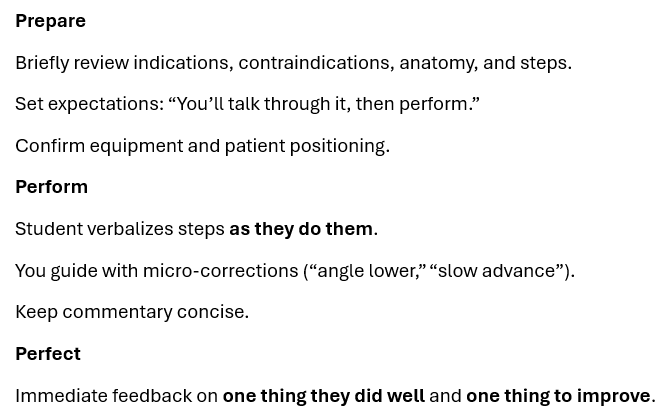
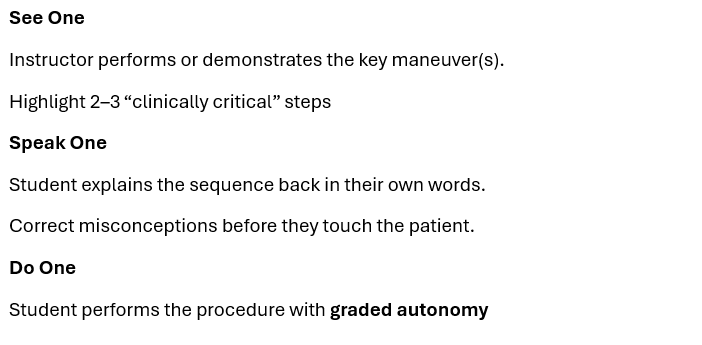
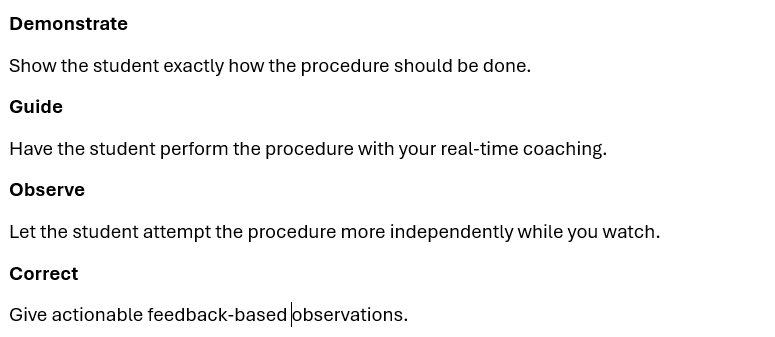
We talk through three frameworks you can borrow from. Peyton’s four-step approach has the teacher demonstrate the skill, break it down, have the learner talk the teacher through it, and then let the learner perform it. George and Doto start by explaining where the skill fits in patient care. Sawyer and colleagues distinguish simulated practice, demonstration of competence, and clinical performance, then explicitly include skill maintenance. On shift, I like having three words in my head to keep it manageable: prepare, perform, perfect.
Key Points
– If you need to quickly spot check knowledge and skill before an on shift procedure, have the learner talk you through the procedure before you go in. An expired kit set aside for teaching makes it easy to rehearse with the actual equipment.
– Pick one thing to watch for. Knowing where the learner has struggled before gives you something specific to coach.
Show them the little thing your hand just did
Josh talks about having to watch his own hand to figure out how he gets an apical four-chamber view. Years of scanning had made those adjustments automatic, which made them surprisingly hard to explain. He describes an intern who couldn’t get a parasternal long-axis view, so they went back to the bedside and he watched her try again. One cue to move down a rib space brought the view into focus, and she got to see what changed while she was still holding the probe.
Key Points
– Watch a rep before giving a cue. You may find they’re doing most of the steps well and need help with one small adjustment.
– Give one cue at a time. When the situation allows, let the learner make the move and see what it does.
Agree on "a safe word"
Before an invasive procedure, I create a “safe word” for both of us to know. It is a little phrase that allows us to pause and correct before something bad happens without alerting the patient or family. Either of us can say, “Let’s pause.” That means we stop moving, take a moment to get oriented, and decide what comes next. Josh also asks early learners to say the important steps aloud as they go, which helps him hear what they’re planning and gives him a chance to catch a skipped step. As learners get more comfortable, he can dial back the narration and watch how they manage the sequence.
Key Points
– Set up the pause before the procedure. When either person uses it, the learner already knows what to do.
– Think about patient comfort and case selection up front. Give the learner a case that fits their experience and the patient’s needs.
Make the next rep about one thing
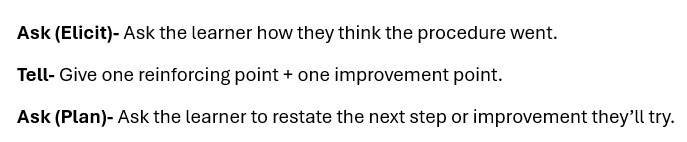
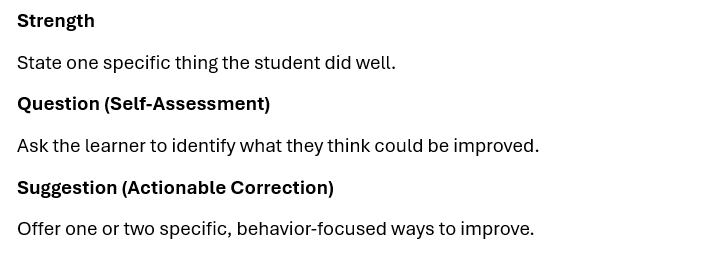
If someone has done a bunch of central lines and keeps running into the same problem, ask them to walk you through their last few attempts. They may realize the sticking point is one transition, like keeping the needle steady while taking off the syringe. That gives you a specific movement to observe, coach, and revisit on the next rep. For the after procedure debrief, I like ask–tell–ask: ask how it went, share what you saw focusing on a positive and an area of improvement, then ask what they’ll try next time. Josh makes a good point about timing here. If the learner’s mind is already on another patient or a difficult conversation with a family, circle back when they can actually take in the feedback.
Key Points
– Ask, “how do you think that went?” Their answer helps you figure out your feedback structure.
– Leave them with one thing to try on the next rep.
Teach for the procedures we rarely get to do
One idea I’m taking from Josh is that the procedures we do all the time give us reps on pieces of the ones we rarely see. Every ultrasound-guided IV is a chance to work on needle guidance, and every focused cardiac scan is a chance to get better at finding a usable window. As educators, we can point out those connections while we’re at the bedside. For high-acuity, low-occurrence procedures like lateral canthotomy, we can use simulation to practice the whole sequence and give feedback before a learner needs to do it on shift.
Key Points
– Name the skill that carries over. Tell the learner what they’re practicing today and where else they’ll use it.
– Use everyday cases to practice component skills, and schedule full reps for the rare procedures.
Conclusion
If there’s one thing I’d take into your next shift, it’s to give yourself a little structure before you teach a procedure. I like prepare, perform, perfect. Before you walk into the room, have the learner talk you through the steps and agree on a phrase either of you can use. Mine is “let’s pause,” and it means stop what you’re doing for a second so we can figure out the next move together. During the procedure, give them room to work and coach the part they’re stuck on. Afterward, give them one thing to try on their next rep. A couple of minutes up front makes it a whole lot easier to teach when things get busy and you’re tempted to say, “Here, just do what I do.”
References
Teaching procedures
1. Burgess A, van Diggele C, Roberts C, Mellis C. Tips for teaching procedural skills. BMC Med Educ. 2020 Dec 3;20(Suppl 2):458. [PUBMED]
2. Walker M, Peyton JWR. Teaching in the theatre. In: Peyton JWR, ed. Teaching & Learning in Medical Practice. Manticore Europe, 1998. pp. 171–180. Book record · Open-access description of Peyton’s four-step approach
3. George JH, Doto FX. A simple five-step method for teaching clinical skills. Fam Med. 2001;33(8):577–578. Full text
4. Sawyer T, White M, Zaveri P, et al. Learn, see, practice, prove, do, maintain: an evidence-based pedagogical framework for procedural skill training in medicine. Acad Med. 2015;90(8):1025–1033. Full text
5. Prepare–Perform–Perfect. Proximie. From subjective to objective: Reaching for perfection with Proximie. Describes how surgical teams can use video to prepare for cases, coach performance, and review afterward. Read the article on Proximie’s website.
Giving Feedback
1. French JC, Colbert CY, Pien LC, Dannefer EF, Taylor CA. Targeted feedback in the milestones era: utilization of the Ask–Tell–Ask feedback model to promote reflection and self-assessment. J Surg Educ. 2015;72(6):e274–e279. PubMed
2. Lefroy J, Watling C, Teunissen PW, Brand P. Guidelines: the do’s, don’ts and don’t knows of feedback for clinical education. Perspect Med Educ. 2015;4(6):284–299. Full text. pubmed.ncbi.nlm.nih.gov